
-
 -Building Safe Futures: Solutions to End Childhood Sexual Violence. Safe Futures Hub (2024)
"School-based self-defense interventions for sexual violence prevention, particularly within comprehensive prevention efforts, have been found to be effective at significantly reducing childhood sexual violence victimization in both humanitarian and stable settings."
Results from 650,000 pre/post participant questionnaires include:
-
 increase in girls' knowledge of how to recognize and prevent sexual violence
46%→ 83%
-
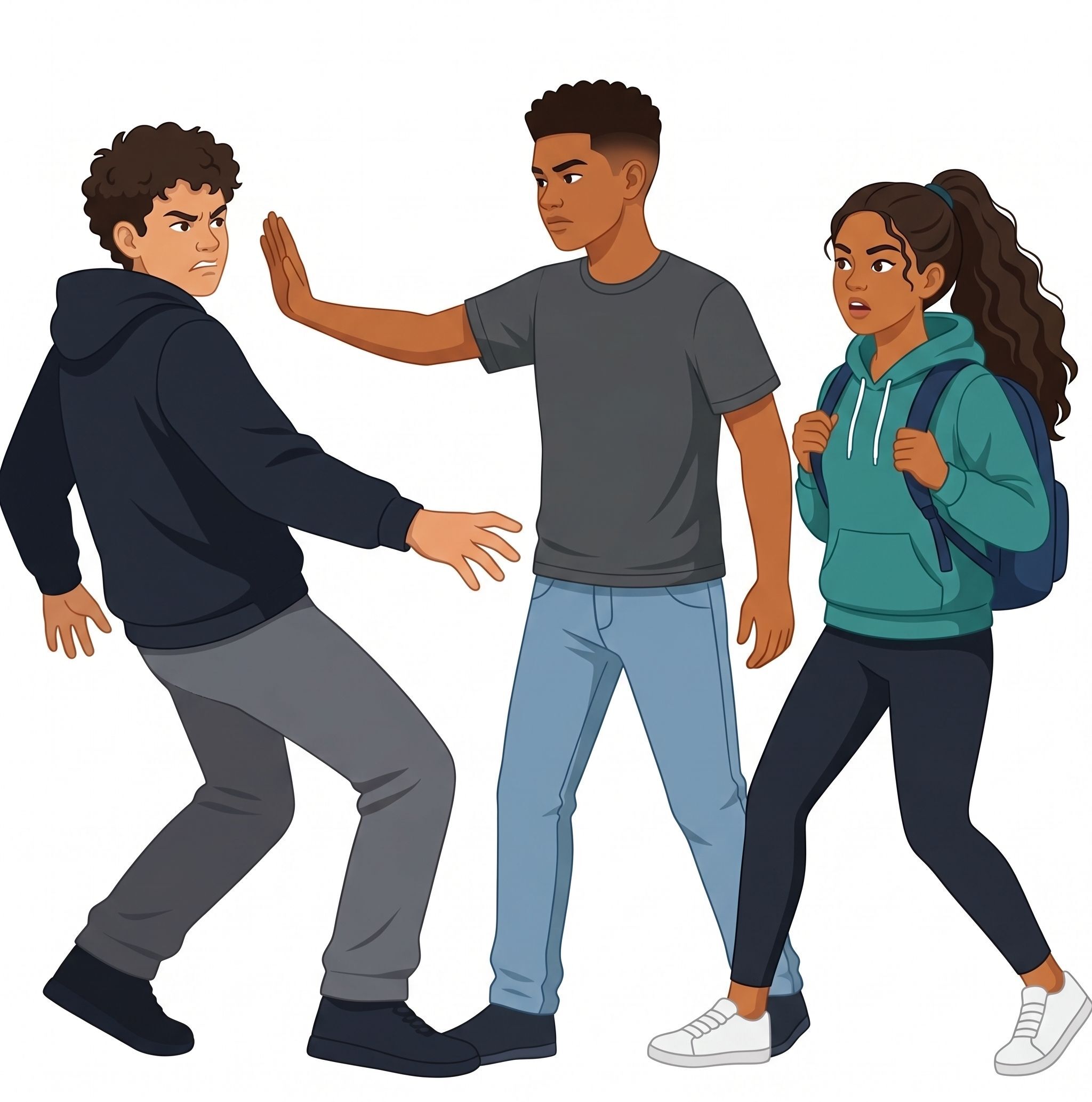 increase in boys' knowledge of how to recognize and prevent sexual violence
31% → 76%
Proven at Scale
No Means No has been proven to be adaptable, scalable, and cost-effective. Over more than a decade, the program has been localized for delivery in classrooms, religious settings, and sports fields in more than 16 countries. It has also been adapted and expanded to be more disability-inclusive, to help young people where rape is being used as a weapon of war, for communities in Latin America with extreme violence and crime, and for Native American communities.
As the program has scaled, cost-effectiveness has increased dramatically. Cost per graduate has fallen from $38 in 2019 to $12 in 2025. NMNW projects that we can achieve a rate of $3 per graduate by 2050 as local ownership and digital delivery expand.
Program Adaptations
-
🇪🇹 Ethiopia
Adapted curriculum to region where rape has been used as a weapon of war.
-
🇭🇹 Haiti and 🇲🇽 Mexico
Contextualized program for urban areas with high crime rates in Latin America and the Caribbean.
-
🇲🇿 Mozambique
Adapted for adolescents with and without disabilities, co-developed with disability-focused partners.
-
🇳🇬 Nigeria
Local partners deepened connections with local Muslim communities by bringing our program directly to their mosques and schools.
-
🇿🇦 South Africa
A 90-minute, verbal-and-mental-skills-only version lets social workers deliver the program after a short online training, no full certification required.
-
🇺🇸 United States
Adapted with and evaluated among Native American youth on reservations in the Great Plains region.
-
🇿🇼 Zimbabwe
Recognized by the Ministry of Primary and Secondary Education; delivered by trained classroom teachers, integrating the program into the formal school system.
Proven to Work
Rigorous external research from Stanford, Johns Hopkins, the University of Nebraska, and others highlights No Means No as one of the few evidence-based programs shown to be effective across multiple settings, with adaptations demonstrating promise in several others. This research is complemented by a broader body of evidence generated through ongoing program monitoring and evaluation, including routine pre- and post-program data, qualitative evaluations, focus group discussions, and other implementation and learning studies across diverse contexts.
-
Key Findings from Independent Evaluations
-
62% decrease in sexual assault
Nairobi, Kenya, Journal of Adolescent Health, 2013
-
38% decrease in sexual assault
Nairobi, Kenya, Pediatrics, 2014
-
39% decrease in sexual assault
Malawi, BMC Public Health, 2018
-
80% decrease in sexual assault victimization
U.S. Indian Reservation, Journal of Interpersonal Violence, 2021
-
76% of boys intervened when they witnessed violence
versus 38% who hadn't taken the program.
Kenya, Journal of Interpersonal Violence, 2017
Together, this extensive evidence base includes 13 peer-reviewed papers published in major scientific journals and consistently demonstrates gains in young people’s knowledge, attitudes, and skills—and in most settings, a reduction in their experiences of violence. As a result, the No Means No model has been highlighted by WHO, CDC, UNICEF, Together for Girls, and the Global Partnership to End Violence in the INSPIRE package as an evidence-based, cost-effective, and replicable approach to sexual violence prevention.
Measurable changes in knowledge and attitudes
Across more than 650,000 pre/post surveys collected between 2019 and 2025, girls' knowledge of how to recognize and prevent sexual violence rose from 46% to 83%, and boys' more than doubled, from 31% to 76%. Attitudes moved with it. Girls' belief in their own worth and their right to defend themselves rose from 57% to 85%; boys' gender-equitable attitudes and readiness to intervene rose from 49% to 83%.
Read the Research
This page shows the highlights. Below are a few featured studies, including what we're still learning. You can read the full research summary at the link in the button below.
- Featured Studies
- A Self-Defense Program Reduces the Incidence of Sexual Assault in Kenyan Adolescent Girls (2013)
- A 6-Week School Curriculum Improves Boys’ Attitudes and Behaviors Related to Gender-Based Violence in Kenya (2015)
- Sexual Violence among Adolescent Girls and Young Women in Malawi (2018)
- Effectiveness of a Sexual Assault Self-Defense Program for American Indian Girls (2021)
- Effectiveness of an empowerment-based self-defense program among South African girls (2025)
-
Featured Studies
-
A Self-Defense Program Reduces the Incidence of Sexual Assault in Kenyan Adolescent Girls (2013)
The founding study: a 62% drop in sexual assault in a controlled trial. https://www.jahonline.org/article/S1054-139X(13)00245-0/abstract
-
A 6-Week School Curriculum Improves Boys’ Attitudes and Behaviors Related to Gender-Based Violence in Kenya (2015)
Significant improvements in boys' attitudes toward women and their likelihood of successful intervention when witnessing gender-based violence.
https://journals.sagepub.com/doi/10.1177/0886260515586367 -
Sexual Violence among Adolescent Girls and Young Women in Malawi (2018)
Replicating the effect outside Nairobi, across 141 schools.
https://link.springer.com/article/10.1186/s12889-018-6220-0 -
Effectiveness of a Sexual Assault Self-Defense Program for American Indian Girls (2021)
The program's effect in a U.S. context.
https://journals.sagepub.com/doi/10.1177/0886260521997942 -
Effectiveness of an empowerment-based self-defense program among South African girls (2025)
Our largest recent cluster-RCT, with a candid look at where results were mixed and what we're doing about it.
https://link.springer.com/article/10.1186/s12905-025-03647-wOur results in this randomized control trial were mixed. Some girls participating in the program even reported experiencing higher levels of sexual assault after participating in No Means No.
What we've learned from this study:
- Violence has become so normalized in some communities that many young people do not recognize that they are experiencing or even perpetrating violence until they participate in a course like No Means No. This could have contributed to the increased reporting of violence from graduates.
- Collecting personal data from young people is challenging. It is essential to create a safe and comfortable space where young people can provide honest responses. While we made every effort to do this, we would strengthen this even more in future studies.
- Online sexual violence is increasing rapidly, and is having a serious effect on young peoples' mental health. We need to increase our response to these forms of violence and integrate digital self-defense into all of our programming.


